Friday, May 30, 2014

Writing is a Personality-Based Skill


For skills (and hobbies, etc) there are two types: Ones that rely on the base of the skill, and the other on someone's personality.

Steve is a lumberjack.

He chops wood with his bare hands.

Steve has a very warm personality with a hint of self-depreciating humor in the form of sarcasm. Now, can he chop wood warmly? Or sarcastically? No. You can't apply personality to the skill of lumberjacking.

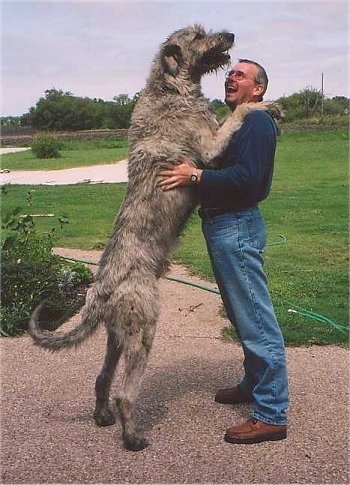
Ellen is a hopeless romantic with a love of cowboys and Irish Wolfhounds.

Who doesn't love dogs that can eat entire sheep?
Ellen's personality is going to factor into her writing in big ways. Even if she's not writing romance books she'll be writing, say, murder mysteries with elements of romance and maybe modern cowboys who are the love interests of plucky heroines who own massive Irish Wolfhounds.

There are more obscure skills, but the fluffy ones (painting, music, arts and crafts) are going to be personality-based whereas industrial (plumbing, electrician) aren't generally. There are some blurred lines (carpentry, clothing) but you should get the picture.

Why bring this up? Because along with personality affecting your writing, it will also affect your writing habits, which I will bring up next. Consider this the introductory post to the upcoming one.

Tuesday, May 20, 2014

The "Everyone is Pirating my Book" Freebie Event!

I've Googled my book several times, and you know what I found?

Lots of people are pirating my book.

I know I'm not a special snowflake. In reality I recognize that Dusted is but a blip in the 31725744359543I3436819436 other books also being pirated (a number so large that I bet you didn't even notice I threw a letter in there, eh?) But I've always not only recognized the fact that Dusted would be pirated, I am entirely comfortable with it thanks to two people.

Cory Doctorow (Ye Olde Lorde of Ye Internete) has offered his book, Little Brother, for free ever since it was released over six years ago. He provides a compelling reason on his website for it that I have followed in much the same vein.

Neil Gaiman, meanwhile, started out as a grump about piracy but, after a few experiments in giving away one of his books for free, now sees it in a new light. The details are in this video (which is 4:30 for you time-sensitive types.)

The information and opinions in both links are ones I have followed closely in my own writing. Dusted is as DRM as I can possibly make it while selling through Amazon, and I have made the price of my book as cheap as it will allow while offering freebie events.

If I were guarenteed the safety of various websites that have pirated copies of Dusted, I would actually provide links (remember, kids, nothing is ever truly free)

They have Smarties and M&M's, and Twizzlers, and fun size Twix, and...
Probably the most legit one would be Lendle. Which sort of "cheats" in how it pirates. Instead of allowing a free download it lets you list which books you own and people can lend each other Kindle books from there. I discovered it through Googling Dusted.

Don't feel like going through shady, back-alley websites so that you can finally get your fix for YA urban fantasy-comedy?

I tried looking for a picture with the word "shady" but I just get getting Eminem so, following logic, he... pirates copies of my book?
Luckily, Dusted will be free this weekend starting May 23rd and going through May 26th, Get It Here!

Happy pirati- er reading!

Friday, May 16, 2014

Get a Free Book From a Local Author!

Hello readers! I've come out of my hidey-hole of posting every ten days (a schedule that is working out beautifully, I might add) to tell you about a local author!

S.M. is a someone that I discovered only a couple of days ago. Her novella, The Circus in Me will be available for free May 17th, you can get it Here! Don't forget to write a review, us wee indie authors need reviews!

Here's the book description from Amazon:

The Circus in Me confronts a girl’s outcast journey. Amish to the bone, born and bred to be as such, Tracey Aliza discovers a magical land outside of her traditional community. On a quest for solitude amongst the vagabonds. She comes as a drifter transforming into a better version of oneself called by the name Trae Lae.

Outside the safety of confinement Trae Lae learns hands-on experiences being an adult in modern society. Struggles to let the past remain behind her she concentrates on performing as part of the team. Back and forth motions bring her to a whole new level of acceptance. College in due course calls to her. Off she flees to the next adventure on the map marked with an X.


Welcome to BYU-Idaho! A Mormon college located on the southeastern region of the great potato state. Trae Lae traces a path in-between a religion she was forced to vacate and another indulging her capacity to a newfound faith that contradicts her soul further. The journey grimy and gray toward the new beginning of endearment. On a mounting podium to seize control of the wild beast conformity. She becomes an acquaintance of a young man by the name of Briggs who is also in torment of historical demons. Their lives intertwine into courses neither of them accused as possible. One girl’s bonnet for another man’s briefs. Do our conclusions meet requirements previously posted? Turn the pages to find out if Trae Lae and Briggs can find a way out of fate’s fortitude. With every whimsical there is a wish, with every star there is a shine, where there is a shunned Amish girl there is bonnet about to be burned.


You can also check out Bjarnson's blog. 

Saturday, May 10, 2014

The Deckle Edge

I love books.

I can hear your blatant sarcasm, you know.
What I mean to say is that I love books. The actual, physical being of them. I love that there's an entire world closed up into one little orthotope, that they come in different sizes, that they often have beautiful pictures on the cover. I can spend a long time just shelving and reshelving books until I get the "feng shui" of them just right.

I let a hipster and a New Age woman battle for the honor of being my feng shui picture. She choked the hipster to death with a string of beads.

Because of my love of books I like to learn lots of little things about them. I know why there are those little backwards-counting numbers on the copyright page (it has to do with the edition number, in case you're too lazy to look it up and want a quick, glossed over answer), and how there is a difference in the binding of hardbacks.

I learned only recently about something called the deckle edge.

It started with looking at different formats for Andrea Cremer's Nightshade I noticed the hardback edition specified deckle edge. Curious, I looked it up. Here's an image as well as some text stolen from Wikipedia, because I'm not in school anymore and can be as lazy as I want with my sources.

I will, however, provide a link for the lazy-but-curious reader.

In manual papermaking, a deckle is a removable wooden frame or "fence" placed into a mould to keep the paper slurry within bounds and to control the size of the sheet produced. After the mold is dipped into a vat of paper slurry, excess water is drained off and the deckle is removed and the mold shaken or "couched" to set the fibers of the paper. Some of the paper slurry passes under the deckle and forms an irregular, thin edge.

The Wiki continues saying that, as technology progressed, the cutting of paper became much easier and cost-effective. However, suddenly deckle edges became "fancy", making people think it was made with a higher-quality paper or was more "Artisan" in its craft. These days machines are built specifically to reproduce the old-timey deckle edge in books, though uninformed people believe deckle edges on their books means the book was made cheaply, or the printing process was defective. For a long time I thought some of my deckle edge books were defective, until I started seeing a lot more of them, then I started to think publishers were getting cheaper with their printing process, resulting in crappily-cut paper. But it's worse...much worse.

They're hipster books.

The hipster recovered, because dying is too mainstream.


Knowing what I do now, I'm still not a fan of deckle edge, and have actually waited for certain books to come out in paperback in order to avoid the deckle edge hardbacks. I just feel like, with their rough edges, they'd be more prone to tearing. Still, it's good to know there's a reason.

Wednesday, April 30, 2014

Writing Yourself Into a Corner

And Loose Plot Threads (Featuring: The Crystal Witch. Coming Soon(ish)!)

This is different from Writer's Block, though it often does cause Writer's Block. Writing yourself into a corner means you can't really get from Point A to Point B in the narrative. You've written yourself into a corner, but you don't want to chop out what you've done because it's required to happen later on into the story.

Right now I'm deep in the writing of The Crystal Witch, so I am currently dealing with plenty of these challenges myself. Note that I say challenges and not problems. Problems are things you need to fix in order for them to go away, a challenge is something you face in order to make yourself (and, as a writer, your story) better for it.

Because of the way I write (all over the place shotgunning narrative like a maniac and mostly making it up as I go rather than planning it all out with a cork board and string like logical, sane people) I end up with this a lot. As a result I have gotten pretty good a figuring them out without it feeling like a totally convenient deus ex machina.

In The Crystal Witch, Gareth (the main character) breaks his swords in battle because they're cheap practice blades. Later on I found myself scratching the top of my head because he's having to fight several times. Initially it creates tension: how in the world is a swordsman going to fight without a sword? This also creates the opportunity to show how smart he can be (by making do without a sword and using something else as a makeshift weapon). Eventually, however, it's going to become inconvenient, and he's going to need a sword. Problem is, how is he going to get one considering the circumstances he's in?

Another example:

I love action, but I also like a dose of realism. I like things to be gritty and maybe even a little depressing. When my hero gets into a fight there is blood, vomit, and a building burning down.

Thanks to Jim Butcher I am pretty much required to make something burn in each of my stories.
This battle wasn't easy and, as part of the "show don't tell" part of writing, I show it in his clothing. Problem was, after that, he had a long journey ahead of him that was in between places that would allow him a change of clothes. Now, I have written myself into a corner where he is forced to either continue wearing those clothes (which, with my "dose of realism" mentality, would begin to stink), or go naked.

Oops.

To solve this I had to take a tiny step backwards so that the building wasn't completely obliterated in the fire, just the part where the battle occurred. This left other parts of the building untouched and, thus, salvageable. Thus, a change of clothes!

Loose plot threads are a little like moments where you write yourself into a corner, but you don't realize it.

A big part of The Crystal Witch revolves around an academy where witch-hunters are trained. In one scene it's mentioned that one of the students, Drake, had a grandmother who was a witch, giving him strange abilities he uses to help hunt witches. In another scene it's mentioned that Gareth was nearly kicked out of the academy because he might have been the son of a witch.

So...is the academy pro-witch background or anti-witch background?

These two clashing scenes could have easily slipped right past me. Luckily they were close together and I wrote down a note to remind myself to fix it in the edit process (I don't edit when I'm in the writing process unless there's something horribly out of place). However, had they been on opposite ends of the story, I might not have even noticed them at all.

However, a fresh pair of eyes (ie: not yours) is more likely to catch it.

Sometimes, however, they don't. This leads you to publishing the story with a plot thread dangling.

Let's pick on Dusted, shall we?

After the scene at Walmart, when they are attacked by faeries, I originally just had them get away, leaving the faeries at the parking lot and getting home safely. This, however, left open the possibility for a "car driving down the road during a battle" scene, so I expanded upon it. This left me with the car being ruined, and that gets fixed as well. They repair the windows and remove the werewolf blood from the seat, which is then given to Crystal.

...Hey, did you guys ever notice when the werewolf blood gets mentioned again? Because I sure didn't, and I wrote the thing.

However, Dusted was meant to be read as a standalone story, with only the possibility of expanding upon it. Crystal does decide right then and there that she's going to throw it away, however...

...Did I mention one of the reason I like Jim Butcher's writing is because he has Checkhov's Guns that span entire books?

Yes, I wasn't planning in doing that originally (oops!), but causing a very minor, loose plot thread to dangle also gave me an "Ah hah!" moment for the future.

These are two examples that you get to learn as you go. You likely won't notice them when you first begin writing. As time goes on, however, you catch and correct them. As more time goes on you instead leave them alone for the most part, stroke your author's beard, and decide how you can make your mistake into something awesome.

Even female authors are required to have beards.

Sunday, April 20, 2014

I've Been Living a Lie

I have to admit, this guy makes a pretty good argument.

So where do I live if Idaho doesn't exist? Probably Skyrim.

This goes on in my back yard at least once a month.

Thursday, April 10, 2014

A Trend That Needs to Stop

I like book covers, it's like a little slice of the story made into a good visual. I am particularly in love with the Italian edition of Moira Young's Blood Red Road. If I could have this as a poster hanging in my bedroom, I would.


But there is a trend in book covers, YA books in particular that needs to stop.

I am talking about the Half of a Face cover (which I will now acronym into HOAF, which sounds like a sound effect for being punched in the stomach.)


I'm not talking about a whole face, either. There are lots of whole faces on book covers, and those, with a few exceptions, are rather uninspired, but the Half of a Face is definitely a theme I'm getting pretty sick of. Maybe all of our super-gorgeous models these days are disciples of some secret order of Harvey Dent we don't know about? Don't know what I'm talking about? Let me show you some examples of covers just from going through the books on my shelf. We have...

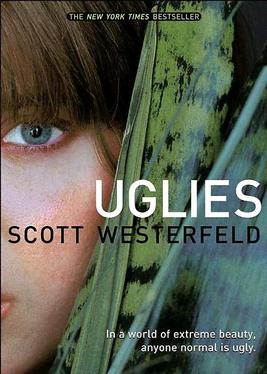
Uglies, by Scott Westerfield:


This the older (and way less creepy) cover. It technically wraps around the book, where there is a whole face, although if they had made the whole face the cover I think it would have looked much better.


The whole series is at fault for following the HOAF theme, actually.

If there's an odd number of eyeballs on your covers, something is wrong.

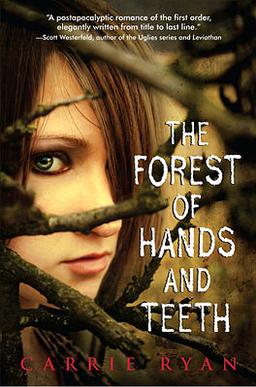
The Forest of Hands and Teeth by Carrie Ryan:


I actually like this cover, but it kind of distracts me that the girl would be wearing eyeliner during a zombie apocalypse. Now, it's believable that a girl would wear some during a recent outbreak, but to give you a time frame for how long zombies have been roaming, the quest of the main character is to find the ocean, which no one in her village thinks is real. It would have to be several generations into the zombie apocalypse, eyeliner being the least of people's problems.

Vampire Academy, by Richelle Mead:


Mostly it's the first one, and I definitely prefer these covers over the new ones, which are faded out versions of these with a giant VA slapped over the top of them...except for the 6th, which is further zoomed in to create the HOAF look.

Trickster's Choice by Tamora Pierce:


Tamora Pierce is a prominent author of my childhood and none of her other books have HOAF as far as I'm aware of.

Delirium by Lauren Oliver:

(Pic refused to work right, so I removed it.)

What is it with girls hiding in the woods? First Uglies, then Forest of Hands and Teeth, now Delirium? I picked this book up about a week ago at a thrift store for a buck, and is the only one listed here I haven't read yet. It sounded dystopian, which drew my interest since the second book has been out, but it also sounds romancey, which made me cringe. It's another of those books that makes me afraid to read it because I've been disappointed so many times since the Twilight craze started.

For comparison, here's the cover's whole face:


I'm not the only person who's noticed this (thank heavens, I'm not crazy) as this gal has pointed out this trend, as well as many more.