Showing posts with label editing. Show all posts

Saturday, June 20, 2015

When You Use a Word Too Much

Sometimes I read old blog posts of mine.

I was trying to get something smug or egotistical, but you get this because the Internet is weird.
I was reading Writing Yourself Into a Corner when I kept coming across a word. That word was "However." A few times it was okay, but after a while it started to bug me, eventually reaching the point where it was like a slap in the face. Seriously, go to that post press Ctrl + F and type "however" into the search box. I use it eight times, twice in a single paragraph!

I don't know if it's the same for everyone, but occasionally I get stuck using the same word over and over again. I was guilty of using the word "just" all the time when I wrote Dusted. I didn't let it bother me as I wrote, but afterwards I did remove about 2/3rds of them. I either removed them entirely, or else replaced them with a substitute when removing it didn't work.

These days sometimes I can catch myself using a word too often. When that does happen I don't stop using it, instead I go do the bottom of the manuscript and make an Overused Words section, which I also use for entire phrases, and keep writing without worrying I'll miss it when the manuscript is finished.

I don't have my Editing Hat on while I'm trying to wear my Writing Hat.

Don't be this guy.

Wednesday, December 10, 2014

Bring on NaNoEdMo!

Most writers are familiar with National Novel Writing Month. I say "most" because a writing friend of mine hadn't, but he's Canadian and I'm pretty sure I've worked around a Canadian long enough to get away with the phrase "Those wacky Canadians!" In a nutshell the rules are that you write a novel in the span of a month. Depending on the total word count you want to achieve depends on the number of words you have to type each day. Frankly I think Novella Month would be more achievable, but people have made some pretty good books under such time constraints.

I don't need that though, you know what I need? National Novel Editing Month.

Yes, I manage to procrastinate editing by more writing. I've written an entire manuscript to procrastinate editing the previous one, and you know what happened? I finished it. Now I have two written manuscripts in which neither have been edited.

Editing goes faster though, since the words are already down. You make a few tweaks here and there, maybe add a whole new scene, but it flies right by compared to writing from scratch. Right now The Crystal Witch clocks in at just over 38,000 words, a novella. Luckily the ebook market is more flexible about shorter stories. So, even if I edited a dismal 1,000 words a night (which is the goal I have each night when writing) I would still have it finished in a little more than a month.

More importantly though, Dusted came out all the way back in June 2012, and I don't want to pass the three year mark without publishing something else. What motivated me the most were two things, two authors really.

The first was Kristen Britain, she wrote a book called Green Rider, I already talked about it here, but the focus is how long it took her to write more books in the series. It wasn't that she was busy with other books like some authors, but it must have been some combination of a busy schedule and wanting to perfect it before release. Still, I dutifully read books 1-3, bought book 4 and have never read it (nor, do I think, I will), and now book 5 is out and I'm not even bothering. It took too long for the author between books, and it has taken her literally decades to get to things that were being foreshadowed in the first few books. Yes, you can always go back and reread books, but there are always new authors and stories coming along with promises delivered faster.

Second, and more relevant, is S.D. Tower. Who in the heck is S.D. Tower? This is an author who wrote a halfway decent book ("halfway decent" meaning I read it back in 2003) called The Assassins of Tamurin and then never wrote anything again. A "one hit wonder" except remove "hit"....and "wonder" too I guess.

Point is, I don't want to be like the first author, but I really don't want to be like the second.

So those are my motivations to edit. It won't be pretty and it won't be perfect, and I can't make any promises that I'll have something before the end of 2014, but I'll be working on it.


Wednesday, July 30, 2014

Dusted Gets a Facelift

I've been talking about it for a while now and it was about a month ago when I did it.

Out with the old...

 And in with the new!


To me both covers are gorgeous, but I feel like the second one grabs attention better. As far as I know anyone who has already purchased the book will keep the old cover, while the new one will show up to new buyers. I also made a few minor grammar and spelling edits as well as extra disclaimer/legalese while I was at it. You can check out the new cover on Amazon here!

Wednesday, April 30, 2014

Writing Yourself Into a Corner

And Loose Plot Threads (Featuring: The Crystal Witch. Coming Soon(ish)!)

This is different from Writer's Block, though it often does cause Writer's Block. Writing yourself into a corner means you can't really get from Point A to Point B in the narrative. You've written yourself into a corner, but you don't want to chop out what you've done because it's required to happen later on into the story.

Right now I'm deep in the writing of The Crystal Witch, so I am currently dealing with plenty of these challenges myself. Note that I say challenges and not problems. Problems are things you need to fix in order for them to go away, a challenge is something you face in order to make yourself (and, as a writer, your story) better for it.

Because of the way I write (all over the place shotgunning narrative like a maniac and mostly making it up as I go rather than planning it all out with a cork board and string like logical, sane people) I end up with this a lot. As a result I have gotten pretty good a figuring them out without it feeling like a totally convenient deus ex machina.

In The Crystal Witch, Gareth (the main character) breaks his swords in battle because they're cheap practice blades. Later on I found myself scratching the top of my head because he's having to fight several times. Initially it creates tension: how in the world is a swordsman going to fight without a sword? This also creates the opportunity to show how smart he can be (by making do without a sword and using something else as a makeshift weapon). Eventually, however, it's going to become inconvenient, and he's going to need a sword. Problem is, how is he going to get one considering the circumstances he's in?

Another example:

I love action, but I also like a dose of realism. I like things to be gritty and maybe even a little depressing. When my hero gets into a fight there is blood, vomit, and a building burning down.

Thanks to Jim Butcher I am pretty much required to make something burn in each of my stories.
This battle wasn't easy and, as part of the "show don't tell" part of writing, I show it in his clothing. Problem was, after that, he had a long journey ahead of him that was in between places that would allow him a change of clothes. Now, I have written myself into a corner where he is forced to either continue wearing those clothes (which, with my "dose of realism" mentality, would begin to stink), or go naked.

Oops.

To solve this I had to take a tiny step backwards so that the building wasn't completely obliterated in the fire, just the part where the battle occurred. This left other parts of the building untouched and, thus, salvageable. Thus, a change of clothes!

Loose plot threads are a little like moments where you write yourself into a corner, but you don't realize it.

A big part of The Crystal Witch revolves around an academy where witch-hunters are trained. In one scene it's mentioned that one of the students, Drake, had a grandmother who was a witch, giving him strange abilities he uses to help hunt witches. In another scene it's mentioned that Gareth was nearly kicked out of the academy because he might have been the son of a witch.

So...is the academy pro-witch background or anti-witch background?

These two clashing scenes could have easily slipped right past me. Luckily they were close together and I wrote down a note to remind myself to fix it in the edit process (I don't edit when I'm in the writing process unless there's something horribly out of place). However, had they been on opposite ends of the story, I might not have even noticed them at all.

However, a fresh pair of eyes (ie: not yours) is more likely to catch it.

Sometimes, however, they don't. This leads you to publishing the story with a plot thread dangling.

Let's pick on Dusted, shall we?

After the scene at Walmart, when they are attacked by faeries, I originally just had them get away, leaving the faeries at the parking lot and getting home safely. This, however, left open the possibility for a "car driving down the road during a battle" scene, so I expanded upon it. This left me with the car being ruined, and that gets fixed as well. They repair the windows and remove the werewolf blood from the seat, which is then given to Crystal.

...Hey, did you guys ever notice when the werewolf blood gets mentioned again? Because I sure didn't, and I wrote the thing.

However, Dusted was meant to be read as a standalone story, with only the possibility of expanding upon it. Crystal does decide right then and there that she's going to throw it away, however...

...Did I mention one of the reason I like Jim Butcher's writing is because he has Checkhov's Guns that span entire books?

Yes, I wasn't planning in doing that originally (oops!), but causing a very minor, loose plot thread to dangle also gave me an "Ah hah!" moment for the future.

These are two examples that you get to learn as you go. You likely won't notice them when you first begin writing. As time goes on, however, you catch and correct them. As more time goes on you instead leave them alone for the most part, stroke your author's beard, and decide how you can make your mistake into something awesome.

Even female authors are required to have beards.

Thursday, March 20, 2014

Writing Progress

I'm going to take a moment to sit down and talk to you. Not at you like I do with most of my posts, but to you.

Yes, you.

As you may know I started this blog as a way to promote my writing. I post the occasional helpful writing tip as well as a plethora of other things.

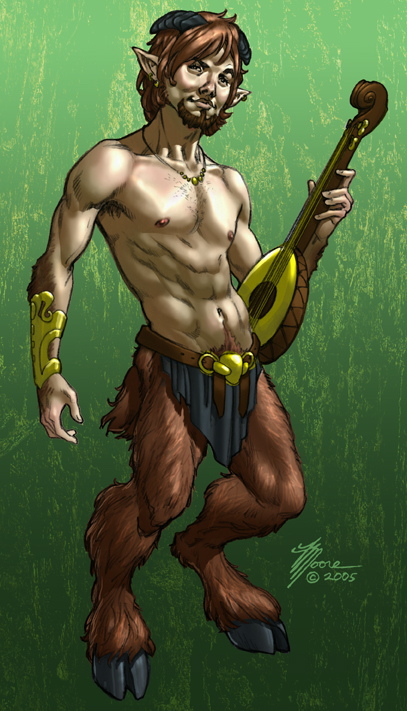
Satyrs anyone?
But I've noticed that, in the process, I don't talk much about my actual writing. Oh I give examples and the like, but if I were to personally ask any of you what I'm currently writing you'd just shrug your shoulders and say "I dunno."

When I gave myself a moment to really stop and think about it, I realized I have never told you guys because I'm afraid of letting you down. I don't want to hype a story only to make you guys wait two, three, maybe even four years (I'm being highly pessimistic here) to be able to read it, and that's if you even get to read it at all. What would be worse than announcing a story only later to scrap it because it never worked out?

The problem with not telling you guys anything at all is that you're left in the dark, and then you might start wondering if I'm even doing anything at all.

But fear not, today that all changes! I trepidly step out into unknown territory and reveal to you guys all of my writing progress, whether it's nearing completion or just a spark in my mind, including what round number of editing I'm in. To give you an idea, Dusted took 3-4 full edits, beginning to end. This won't be an exact number for all of my manuscripts, as the length of the story and how much work it needs will vary. Some may require only a few editing rounds, some may need tons.

So, here is my honest progress (the number of them should also show you why you shouldn't pitch your own ideas to writers):

Dusted: Needs new cover and editing.

All Just Survivors: On editing round 2, has 76,395 words. Procrastinating. (To give you a comparison, Dusted clocks in at 74,858 words, and it gained 10,000-20,000 words after editing.)

The Crystal Witch: 17,192 words in. Current focus.

Dreaming (AKA: Dusted 2: The Dustening): 32,963 words. Currently on hiatus.

The Witches of Dunraven (working title): 13,408 words. Resisting urge to work on it so I can focus on other, more complete works.

Lady of Crows: A spark. Resisting urge to even start it so I can focus on other work.


So there they are. This doesn't even include abandoned works, ideas that aren't even a spark yet, or works that need reviewing or writing, but aren't even on the back burner (mentally double or even triple this list for that.)

The problem is, when it comes to writing, I work best at shotgunning. I used to force myself to work on one thing at a time, but that often caused me to lax, sometimes for months at a time. By shotgunning, I'm all over the place. When I find myself getting tired of one thing, I'll jump to the other and work on it until I'm feeling up to working on the first one again. I'll admit, I probably won't get something done in a reasonable amount of time, but it's far more efficient than burning out and doing nothing at all. Best of all, when someone else is helping to read through and edit one manuscript, I'm working on yet another.

Have any questions? Curious about any of them? I'd be happy to provide descriptions of them (note that the less they're worked on the more vague of an answer you'll get). A few people have asked about the sequel to Dusted, so expect to hear about that in more detail another time.

Friday, June 28, 2013

Signs You're Not Ready to be a Professional Writer

Here are a handful of examples that show you either aren't a writer, or that your current manuscript will be going nowhere. Some are actual examples from people I've helped out, others are from my own learning, and some are, hopefully, common sense. Don't fret though! This isn't written so much to poke fun at people (except maybe myself), rather it's a list that you want to use to evaluate and see if there's a mindset you need to change if you want to continue writing.


1. You fantasize more about writing than you actually write.

2. You don't even have a name for it yet.

3. You slam something out and then immediately ask someone to read it.


"Who is she insult Untitled. the epic I wrote in only two hours?
4. You have picked out the actors who will play the main roles of the movie adaptation.

5. You think it will be the next X (X being whatever is a best-seller. Twilight, Harry Potter, Hunger Games.)

6. You refuse to make any edits. This book is your baby!

7. You refuse to change any characters. They are your children!

8. You spend more time watching your Sim write a novel than you do actually writing a novel.

She wrote a bestseller!...but you still have only 5 pages on your own work. 


9. Writing feels too much like homework, and you never do your homework.

10. You will only accept your single short story to be published by an actual publisher, in hardback, no exceptions.

11. When someone critiques your story, you are crushed when they point out something wrong with it.

12. u r a bad speler

13. u hav bad gramer 2

14. You write in a genre because it's currently popular.

15. You write because you want to make gobs of money.

16. Once you finished writing, you're done, no changes needed at all.

17. You assume an editor will just fix everything.

18. You don't read.


Friday, May 3, 2013

The Process of (not) Editing)

A step-by-step process of procrastination.

Well, now would be a good time to sit down and start editing.
I have to pee.
Ahhh.
Now I'm hungry.
Oh I should do some laundry!
Hey wait, I said I'd change my bedsheets.
I should probably find some clean sheets first.
There they are! Wait...those aren't sheets.
Oh well maybe I can just get rid of the electric blanket instead.
Man it feels good to get rid of that blanket, I've been getting way too warm.
Let me check for sheets again.
Nope, still can't find any.
Oh yeah, I was going to do laundry.
Bleh, I want to eat something first.
Waffle!
Back to laundry...but first let me check for clean sheets one last time.
Still nothing, I give up.
Lalala, sorting laundry.
Okay, laundry is now in the washing machine.
Time for some editing!
A Steam friend sent me a video link.
Haha, what will the Internet think of next?
I should write a blog post about procrastinating...
Hey I wonder if (insert author here)'s blog has been updated?
It has!
I need to shower.
My nails are getting pretty long.
Time to move the laundry into the dryer!

Several hours later and still no editing done.

Tuesday, August 21, 2012

Rules for Editing (Editing)

Okay, so technically it's supposed to be a Publishing advice day, but I don't have anywhere for editing, and both are thinner than the rest of the categories, so why not?

While editing some people's manuscripts, I've started to come up with my own set of rants rules for the writer before it is given to people to read and review. This counts for anyone doing it for free. If you're paying someone, I guess it's your money, and it's their income, so whatever.

Perhaps most importantly is my Number One (No. 1, #1, numero uno, unus, ena, in case I didn't make it clear enough): Review it yourself first.

That bears repeating.

Number 1: Review it yourself first.

I'm reviewing it for plot points and character development, not basic grammar and weird sentence structure. Those are things you're going to catch on your own if you just read it. I'm a Writer, Jim, not an English Teacher. I don't want to spend an hour writing advice to you about hyphens.

And that's why all my friends have scars.

Number 2: Tell me what you want reviewed.

I don't want to spend an hour writing advice to you about hyphens, only to find out that's not what you wanted.

Tell me what you want, Writer, and I will give it to you in my review. There's only so much I can do, I can't rewrite your entire manuscript for you, and there has to be one thing about your manuscript in particular that's bothering you. Even if it is spelling or grammar, I can do that, but you have to tell me. The more detail you give me, the better. If someone says, "I don't feel like Brandon Badguy is evil enough, what can I do to make him better?" By golly I'm going to focus on Brandon Badguy and give you some advice, because that's what you specifically asked me to do. If you say "Review this" and throw me a stack of papers (be they a stack of actual papers or a big .doc file) and tell me nothing, you're going to get a reviewing mess. It's going to be helpful, yes, but it's not going to be the best review that it could be.


Number 3: Expect it to take a while.

I have my own things to do, I have my own life. I'm not going to drop everything I'm doing, no matter how awesome your magical manuscript is. I have goats escaped from a fence running rampant on the road, I have chickens to feed, I have a kitchen to clean, I have a Windows Server 2008 class every Thursday and Friday (Flexible Single Master Operator, y'all!). Those are Real Life things, but those are to be expected from the Writer, what Writer doesn't seem to expect is that Reviewer has other things too: I'm writing my own work, I'm reviewing my own work (because I follow Number 1), I'm reading a book, Minecraft just got updated this week, Steam had a sale on Deus Ex, my kitten just bounced off my face and we are now participating in a Benny Hill-esque scene in the backyard. Anything could be happening, so that it could take weeks and weeks, if not months and months, to review your manuscript.

I don't want to spend all day sitting at my computer, the white background of Microsoft Word as the only source of light strong enough to give me a tan darker than Gollom's, to review your manuscript from start to finish.

I'm not getting paid for reviewing your manuscript, so I'm not likely to be professional about my schedule.


Number 4: First come, first serve.

I'd never had this one happen to me until recently. Someone sent me their 60k manuscript to review, and then another friend sent me their short story. I'm sorry, but I'm going to review the 60k word manuscript first. Why? Because it was sent first. Size doesn't matter, if it did, I'd be reviewing nothing but short stories while my friend's 60k word manuscript would gather dust. He worked pretty hard to write all of that up, rather than crank out short story after short story, it's only fair I review it before getting to those dozens of short stories.

Don't expect me to put the finishing touches on Writer 1's manuscript, and then turn around and pull up Writer 2's manuscript, either. I'll probably take a long break between them.


Number 5: If I bother to read something of yours, you'd better read something of mine.

It's only fair. I'm working for free here. You want something read or reviewed so badly you're asking me to do this for you. You should be able to do the same for me. I've never been more miffed, and therefore slow, to review someone's Manuscript 2 because they didn't read something of mine when I reviewed their Manuscript 1 months ago.


Number 6: Number your chapters.

I never thought I'd ever have to say this, but that 60k manuscript? It didn't have chapters. It had end and beginning chapter points, but not actual chapter numbers. I'm not going to review it in one sitting, so please give me a jump point. The way I have been navigating through this manuscript is by copy-pasting a chunk of random text "growing on the other side of the fence" for non-literal example, and putting it in a different Word file with START REVIEWING AGAIN HERE written next to it so that I can do a Find option and look from there.

I don't want to have to do that.

When I finish, I want to end where it says Chapter 6. To know where I stop, I want to write "On Ch6" on a piece of paper at my desk. When I pick it up again, I want to use the Find function and type "Chapter 6" and instantly bounce there to continue my work. Anything that inconveniences me even just a little bogs me down a lot more than you'd think.


Number 7: Warn me ahead of time.

An old friend of mine asked me to review a story of hers, but she didn't tell me what the fanfiction was based on...or even that it was a fanfiction in the first place. Instead, I had to use what little I knew about the show it was based on to figure out it was a fanfiction based on the show.

Along with your manuscript, provide a quick and dirty synopsis of the story for me, including characters, so I'll know where I am and what to focus on. I don't want to focus on Lilly, only to find out she's just a shopkeeper and only appears in a single scene. I don't want to review an entire manuscript, only to find out your main character is an OC in an I Love Lucy fanfiction. Fanfiction reviews differently, tell me what it is.

This dog is a better editor than me.


Number 8: Don't expect professionalism.

I'm not an editor, I never learned how to edit, and I'm doing this for free. I have no idea what I'm doing.


Number 9: I'm doing this for free.

I can't say this enough. I'm doing this for free. I'm not getting paid for this. You didn't drive a truckload of money up to my house. It's from the goodness of my own black heart. Keep all of that in mind.


Number 10: Review my review.

Like I said before, I have no idea what I'm doing. As a writer, the only way you're going to get better is to keep writing, and for people to point out your strong and weak points. As a reviewer, the only way I'm going to get better is for all of you to leave me alone you to point out my strong and weak points. I've reviewed a lot of stuff, and I don't even know if I'm doing a good job, or making their once beautiful manuscript into a smelly mess because they never told me if it helped or not. So, as far as I know, but I could, potentially, keep ruining people's work because no one told me I was wrong.

Even something as "It helped me" or "That's not what I wanted" can be helpful. With only 2 exceptions, whenever I've reviewed a manuscript and returned it to Writer, I have never heard about the review, or the story, ever again. Tell me if I was able to point out errors in a clear manner, tell me if something I did was confusing, tell me if I reviewed a part weirdly.


Number 11: DO NOT TOUCH

Don't touch the manuscript when I'm editing it. This is almost as important as Number 1. Review it yourself, but once you give it to me? Stop. Nothing is more frustrating to me than to make a huge review of something, and then find out the writer nixed the entire scene, making my hours of reviewing worthless.


These are just my rules, and I'll probably come up with more as time goes on, but if you just keep these in mind, the world of writing and for-free-editing-by-friends will be a much happier place.